“Give me your tired, your poor
Your huddled masses yearning to breathe free.”
One hundred twenty-two years have passed since The New Colossus was mounted on the Statue of Liberty in New York, the symbol of freedom that promised thousands of visitors from all parts of the world a refuge for the tired and the poor. In a time not far in appearance but distant in decades, in 1964, New York police stormed a small theater in Greenwich Village and pulled comedian Lenny Bruce from the crowd as he performed his show. Bruce had not assaulted anyone, nor threatened anyone; his charge was his words — his boldness in criticizing U.S. policies in his comedy act. His arrest became an early symbol of the fragility of free expression, even in a city celebrated as the capital of open debate. The question remains: Are Americans still breathing that freedom since then?
Six decades later, separate that moment from the rapid sequence of events in the past two years, a series of violations of freedom of expression that was originally guaranteed in the Constitution. Not only in New York, but across 50 states, and although the violations differed in scale, they shared the same debate over the freedom of speech.
The United States has witnessed an unprecedented wave of restrictions on expression in recent years. This came as a result of several factors, most importantly the escalation of political tensions due to wars and global conflicts, rising internal divisions regarding human rights and justice, and severe pressures in other places such as university administrations that feared losing funding or harming their reputation. These administrations moved to suppress student protest comments, discipline and investigate faculty who expressed solidarity, and fire them. This extended to workplaces of various types as well.
The state of free speech across the U.S.
A 2024 report from the Foundation for Individual Rights and Expression (FIRE) stated that 10 to 14 percent of faculty members in the United States were punished or threatened because of their expressed views, equivalent to tens of thousands of professors statewide. Another report for the same Foundation indicated that about 1,014 students were targeted or punished for opinions that were supposedly legally protected.
“We have seen from the Trump administration an attack on free expression that is unlike previous administrations in its directness and its expansiveness,” said David Snyder, Executive Director for the First Amendment Coalition. “So there have been people who’ve been taken off the streets and put into detention. It appears purely for opinions that they expressed”.
Snyder’s comment refers to recent cases in which federal and local authorities have taken action against individuals for their political views. An example was the Tufts University graduate student Rümeysa Öztürk. A Turkish national, she was arrested on March 25 by masked ICE agents for an op-ed she wrote in a campus newspaper criticizing her school leaders’ response to the Israel-Hamas war in Gaza. Another example involves the Los Angeles Police Department, which committed at least 15 press-freedom violations during the No Kings protest in October 2025, even after a federal injunction barred officers from interfering with journalists. These cases illustrate the kinds of government actions Snyder describes as unprecedented in their directness and scope.
Snyder said it is “highly unusual” for the government to simply admit that the reason it’s putting somebody in detention and potentially deporting them is because of, for example, an opinion piece that they wrote in a university publication.”
Concerning universities and the application of freedom of speech within them, Snyder explained that the protection of free expression depends on the type of institution.
In the United States, the primary source for freedom of expression, along with several other freedoms, is the First Amendment to the U.S. Constitution, which protects five core freedoms: freedom of speech, freedom of the press, freedom of religion, freedom of assembly, and freedom to petition the government. These protections apply against government action. So if the government punishes, restricts, or censors your speech, it may violate the First Amendment.
The First Amendment protects individuals only from government actions, so private universities in the United States are not constitutionally obligated to uphold free speech in the same way, except in states like California, where special legislation such as the Leonard Law requires private universities to extend rights similar to First Amendment protections.
Snyder added that the situation differs when the institution is a public university such as the University of California, California State University, or public community colleges. In these cases, any punitive action based on political opinion may constitute a First Amendment issue because these institutions are government entities.
Snyder also noted that protections for professors sometimes depend on a concept separate from the First Amendment, known as academic freedom. This concept does not come from the Constitution but from employment contracts, university policies, and academic traditions. Many universities have rules that protect professors from disciplinary actions related to their opinions, but these protections are not necessarily constitutional, they are institutional frameworks.
The country has witnessed a series of punitive actions against individuals who refused to comply with restrictions imposed on their opinions. Last October, Indiana University fired its director of student media, Jim Rodenbush, after he refused the university administration’s request to delete news content from the student newspaper. He later stated that he does not accept censorship or any act that limits the independence of the newspaper.
The Journalism Association of Community Colleges stated that Indiana University’s decision to remove Rodenbush and shut down print production of the Indiana Daily Student “represents a troubling attack on press freedom and student editorial independence.”
In the recent killing of Charlie Kirk, more than 50 college professors have been fired or disciplined for comments about Kirk, according to the American Association of University Professors.
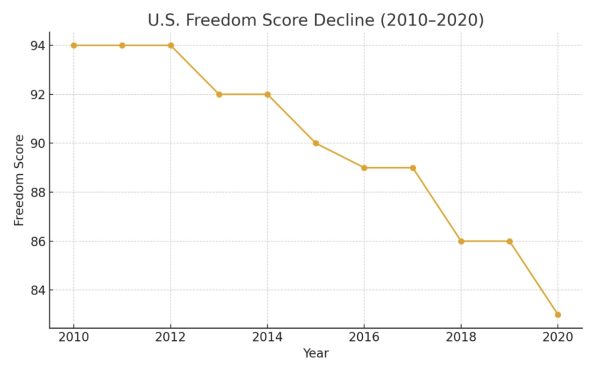
These cases share a common outcome of arbitrary dismissal, despite differing in their causes. They have raised concern across U.S. society. Freedom House’s annual Freedom in the World report found that the United States’ democracy score declined by 11 points on a 100-point scale over the past decade. Key concerns highlighted in that report included mass arrests and violence against journalists at protests, the dismissal of inspectors general and other violations of norms meant to prevent abuse of office, lack of transparency, and misinformation related to the COVID-19 pandemic.
The United States’ freedom score declined by 11 points over the past decade, according to Freedom House.
The turbulent climate of freedoms during this period pushed many to prefer staying on the sidelines despite supporting colleagues who faced oppression for their expressed views. What
This report presents cases and numbers that proves that political expression punishments are not theoretical debates but real incidents happening in measurable numbers.
A debate over free speech at Contra Costa College
Contra Costa College was not isolated from this controversy over the idea of free speech.. Around this time in November 2024, the Contra Costa Community College District placed CCC philosophy and humanities professor Asad Kabir on administrative leave for sending emails on faculty and staff email listservs detailing his thoughts on the conflict between Israel and Palestine, a move that Kabir’s supporters saw as a violation of his right to freedom of speech.
According to documents obtained by The Advocate, investigators concluded that Kabir violated five district policies by expressing his “personal opinion” in emails sent to district listservs.
Due to the contents of the emails Kabir sent out on Oct. 21 2023, Oct. 31 2024 and Nov. 1 2024, the investigator found that Kabir expressed his personal beliefs on the conflict between Israel and Palestine and therefore expressed his “personal opinions” and “failed to observe all relevant regulations and policies”.
As a result, it was determined that Kabir had violated the district’s policy Implementation Guideline 2012.01, which discusses the district’s purpose and guidelines for email distribution lists and Board Policy 5030, which outlines the district’s acceptable technology use policy.
A group of 4CD community members including faculty, staff, and local supporters issued a statement expressing solidarity with Kabir earlier this year. In their message to the district administration, they described the decision as a “disproportionate response,” noting that faculty and staff routinely share personal announcements through work email “without facing similar consequences.” They further argued that if the action taken against Kabir was motivated by the content of his messages, then the district’s response is “inherently political and a violation of our shared commitment to free speech.” The statement also noted that restricting or censoring email communication related to Palestine constitutes discriminatory treatment “grounded in anti-Arab and anti-Muslim racism.”
One year after the incident, The Advocate contacted the professor to ask about any updates. He told us:
“The head of HR asked me if I would accept the conditions mentioned in their last letter, which meant the same route of silencing faculty and staff in sending any email about the genocide of Palestinians in Gaza by Israel (as he described). I rejected these conditions and consequently they terminated my teaching at Contra Costa College. I rejected their conditions so they didn’t assign me any courses. It seems my teaching career is over and I have entered into a forced retirement.”
Kabir added:
“You can see the double standard wrapped in legal terms and duplicity. It is obvious that they have been trying to silence us not to speak about genocide in Gaza. But they pretend that they are enforcing a common rule.”
Regarding professor’s final termination decision, the District Director of Communications and Community Relations Jennifer Ortega, said:
“We cannot comment on personnel matters.”
She attached the district policy stating that: “District information technology resources must not be used for partisan political activities.”
While Snyder, the FAC executive director, said he could not weigh in specifically about Kabir’s situation without more facts, he said generally, community colleges cannot punish faculty for their viewpoints.
“On the surface, the incident seems suspect. Government-run community colleges generally cannot punish speech based on viewpoint except for narrow exceptions,” Snyder said. “If a professor was fired simply for political expression, that is concerning, but I can’t judge without more facts.”
The Advocate reached out to Marina T. Crouse, President of the United Faculty across the Contra Costa Community College District, to ask about their role when teachers face violations. She said:
“I am not at liberty to discuss any part of a unit member’s status or their case as it would violate confidentiality. However, the union’s job is to advocate for and protect workers by upholding what is outlined in the contract. If management violates the contract, then the union steps in. If a union member allegedly violates the contract, or other district rules or procedures, then the union helps to represent that member and navigate any discipline that may take place.”
Kabir said his case opened up discussion on free speech.
“Along with Gaza genocide we have entered an era of suppression of speech and basic rights of people, especially the rights of faculty and students,” Kabir said. “Since October 7th, so many outspoken faculty were fired and so many students were dropped from college. This is the time in which we are living, and resistance, organizing, and solidarity is the best path to go.”