On February 3, 2026, the Richmond City Council voted to draft an ordinance to make Richmond an Ice-Free Zone — a proposal that would further its status as a sanctuary city.
Councilmember Claudia Jimenez and Vice-Mayor Doria Robinson proposed an ordinance that would prohibit U.S. Immigration and Customs Enforcement (ICE) from using city property and resources for enforcement.
“This proposal is to add to what we already have with more policies and procedures to make sure our community, and particularly our immigrant community, is safe and protected,” Jimenez shared at the start of her presentation.
The plan would require the City Manager and City Attorney to review the ordinance’s legality and prepare a draft of the ordinance by March 3, 2026. Six of the council members voted in support of the plan, while Councilmember Jamelia Brown abstained.
“I just want to make sure that there are no overpromising protections that we cannot legally guarantee…I’m supportive of the intent of this item, but the scope seems so broad,” Brown explained prior to abstaining.
A disagreement ensued among the council members over the legality of what an ICE-Free Zone truly signifies and whether the ordinance’s goal is legal. While state and local governments cannot override federal law — such as Title 8 of the United States Code which allows ICE to detain individuals — various Supreme Court rulings like Printz v. United States prohibit the federal government from commandeering state and local law enforcement.
How the ordinance will consider case rulings and laws such as these is not yet known, but the draft proposal on March 3 will be the first of many meetings to discuss these details.
“The ordinance has to come to the council multiple times,” Robinson explained regarding the process of the ordinance. “The job of the City Attorney’s office is to make sure it’s legal and to confer with other departments…to ensure that whatever draft comes forward can endure legal scrutiny,” Robinson concluded.
Richmond has a long-standing history of setting boundaries between immigration enforcement and the city’s residents. Richmond passed its Ordinance No. 29-90 surrounding protocols for contact with ICE in 1990. It became an official sanctuary city under Ordinance No. 12-18 in 2018 and has since strengthened its status through various legislation, the latest of which was passed last week.
While its predecessors established protocols like a chain of command and limited engagement when it comes to ICE, the new ordinance is expected to create more specific boundaries. Signage designating ICE-free zones, emergency planning protocols, and complete prohibiting of city property for immigration enforcement are all aspects of the proposed draft that were not explicitly explained in previous legislation.
The strengthening of legislative protections for Richmond’s immigrant community was prompted by the recent ICE raids in Minneapolis, Minnesota and the killing of Alex Pretti and Renee Good.
“We’ve been seeing around the nation what’s happening in different cities from Minneapolis to Chicago to L.A. We should also consider in light of the murders of Renee and Alex…what we do if federal agencies are lawless — what can we do? It’s our civic duty to be prepared,” Robinson shared in context for the proposal.
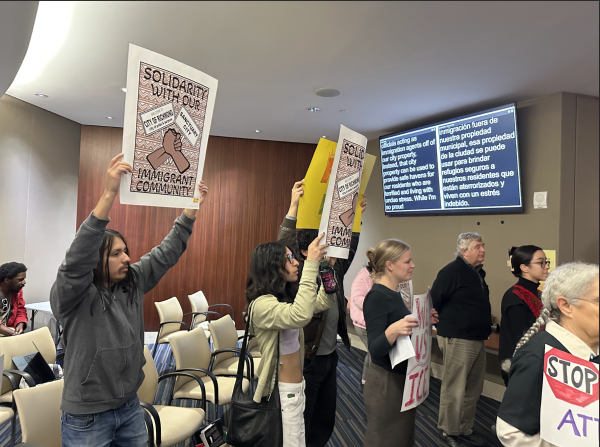
During the consideration of this agenda item, the city council chamber was crowded with posters of support for the ordinance. Community organizations like Reimagine Richmond and Richmond Progressive Alliance banded together to show support for the ordinance.
“There continues to be so much panic in our community right now. Right now is the time for our city to step up and ensure that Richmond stands with its immigrants,” Reimagine Richmond member Andrew Melendez stated in their public comment.
Richmond joins San Jose, Santa Clara, Alameda County, and Pinole in the process of becoming an ICE-Free Zone.