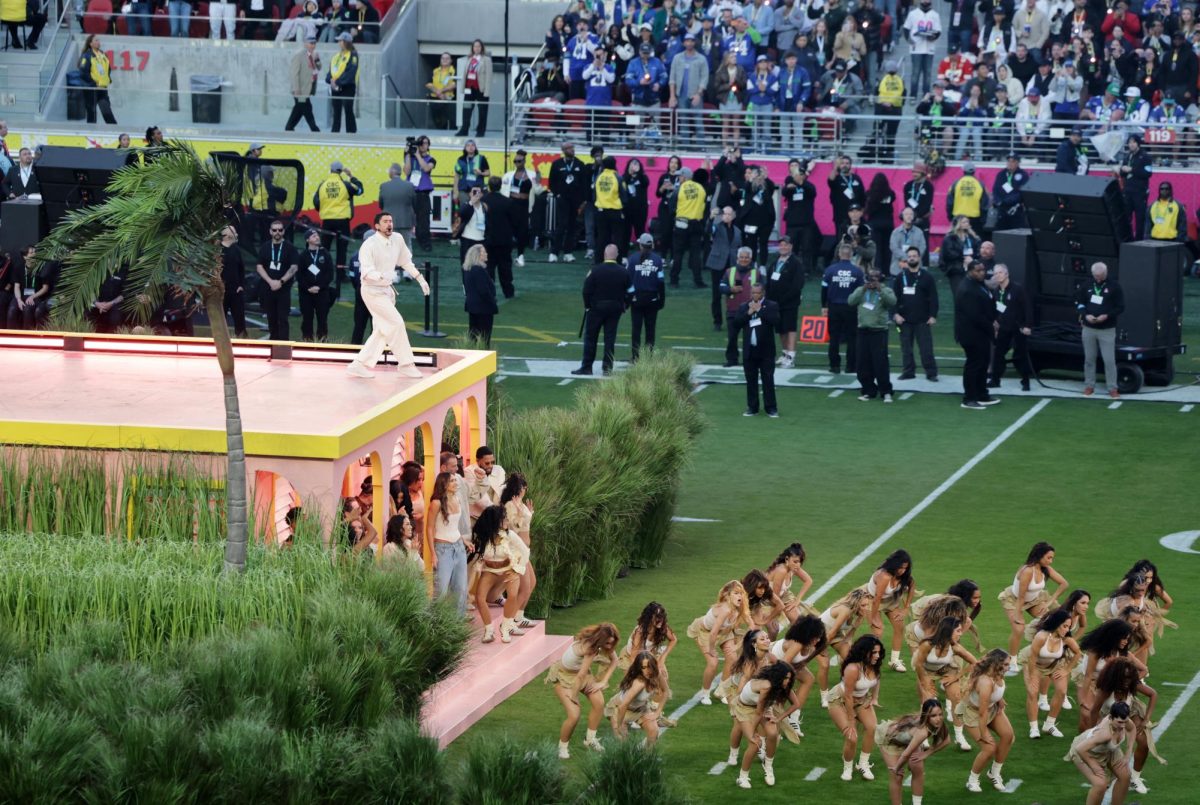
Seeing Puerto Rican global artist Bad Bunny headline the halftime show at the 2026 Super Bowl sparked conversations across the campus of Contra Costa College in the days that followed. For many students, watching one of the most viewed broadcasts in the country, the moment felt bigger than entertainment.
“It feels like a major step forward for our generation,” said Michelle Conway, a second Sociology major at CCC. Conway explained that American culture “isn’t one thing anymore. It’s diverse, global, and evolving.”
Mario Delgado, a second year history student at CCC, said seeing a Spanish-speaking artist headline the nationally televised event made him “proud” of his culture.
Rainah Green, a first-year business student at CCC, described the performance as “symbolic,” adding that “America is diverse, whether some people like to admit it or not.”
For these students, the halftime stage represented more than music. It reflected who gets visibility in American culture.
The halftime show by Bad Bunny was more than just a performance. It was a declaration. Students and viewers from the Bay Area and beyond contemplated, honored and discussed what it means to see their culture represented on a large platform. In addition to football and touchdowns, this year’s Super Bowl was about representation, identity, and the unifying force of music. That is why this year felt significant.
For decades, the halftime stage largely reflected a narrow version of American pop culture. While the music industry has always been shaped by Black and Latino influence, visibility at the highest commercial levels has not always mirrored that reality. The influence has always been foundational but the visibility not so much. Scholar Raquel Z Rivera notes in her book, “Reggaeton” that reggaeton music emerged from Afro-Caribbean communities in Puerto Rico and Panama, yet has often been racialized and positioned at the margins of mainstream acceptance. Against that history, seeing a Spanish-speaking Latin artist command that platform without compromising his language or cultural identity signals that the definition of mainstream is shifting.
As someone who grew up in Richmond, California, a community shaped by immigrant families, cultural diversity, and economic struggle, I understand how powerful visibility can be. Music has always been more than entertainment in communities like mine. It is identity, It is pride, It’s a declaration that we exist in spaces that have not always centered us. Watching that halftime show did not feel like a simple pop culture moment. It felt like acknowledgement.
Representation at this scale matters because national platforms shape perception. The Super Bowl is not niche programming. It is a shared cultural event, families watch it together. Social media explodes during it. Headlines dissect it. When millions of viewers see a Spanish speaking artist headline the show, it subtly reshapes assumptions about who belongs at the center of American culture.
Some people say entertainment shouldn’t mix with identity or politics, like a halftime show is just moves, vocals, and lights. But that misses the bigger picture. In the book “Outlaw Culture,” bell hooks argues that popular culture is a powerful site where race, gender, and power are constantly negotiated. Similarly, in the book “Borderlands/La Frontera: The New Mestiza,” Gloria Anzaldua explores how identity is shaped by borders, language, and cultural hybridity, showing that artistic expression often becomes a space where marginalized communities assert who they are. Together, their work shows that art is never just art but that it is tied to culture, community, and the world we live in.
Choosing a performer is a decision. It reflects marketing strategies, audience expectations, and corporate calculations. It also reflects cultural priorities. When the NFL selects a global Latin artist to headline its biggest event of the year, it acknowledges a demographic and cultural reality that has long shaped the country. The United States is multilingual,it’s multicultural. It is influenced by migration, diaspora, and global exchange. The halftime show simply mirrored that truth.
Of course, representation alone does not dismantle inequality. A fifteen-minute performance does not solve structural barriers in media, education, or politics. But visibility is not meaningless. It creates space. It expands imagination. It challenges outdated ideas about who can dominate a national stage without altering their identity to fit a traditional mold.
Moments like this also test the country’s comfort level with change. When representation expands, resistance often follows. Some viewers question whether such performances are too political or too cultural. But the discomfort says more about expectations than it does about the performance itself. If diversity feels political, it is only because exclusion was once normalized.
What stood out most to me was not just the music, but the reaction afterward. On campus, conversations were layered. Students were not only talking about production value. They were talking about meaning. That distinction matters. It shows that younger generations are paying attention to symbolism. They recognize that who appears on screen influences who feels seen off screen.
American identity is not static. It has never been confined to one language, one race, or one cultural expression. It evolves with every generation. The 2026 Super Bowl halftime show reflected that evolution rather than resisting it. It acknowledged that cultural influence does not require translation to be legitimate.
For students at Contra Costa College, particularly those from immigrant or first-generation backgrounds, the performance felt validating. It felt like a reminder that their culture does not exist on the margins. It is at the center. And when the center expands, the definition of America expands with it.
In the end, this was never just about a celebrity performance. It was about visibility on scale. It was about what it means to see language, heritage, and identity amplified on one of the largest stages in the country. That visibility may not solve every inequity, but it signals movement.
The halftime show was more than entertainment. It was evidence that American culture is broader, louder, and more layered than the narrow versions often presented. And for many watching, including students right here in San Pablo, that shift felt both overdue and necessary.