
In just a few months, students at Contra Costa College will miss receiving text messages beginning with “COMETS” on their phones.
Inside the Student Services Building, the lights will turn off in the office that served as a place where students sought advice or help with registration problems.
The space where Rod Santos spent seven years serving students will soon stand empty.
Santos is being forced to leave his position after being notified that his role as dean of enrollment services has been eliminated by a decision of the Contra Costa Community College District Governing Board.
The decision comes as the Contra Costa Community College District faces growing financial pressure. District officials say the system is confronting significant budget challenges, including declining enrollment at some campuses and changes in the state funding formula.
On Feb. 11, the Contra Costa Community College District Governing Board approved the elimination of two positions at Contra Costa College — the dean of enrollment services and a DSPS learning disabilities specialist — as part of a series of budget reductions. Two other management positions – one each at LMC and DVC – and another faculty position at DVC was cut, too.
Weeks later, The Governing Board eliminated nine classified faculty positions.
Rod Santos, who has served in the position for seven years, said he learned about the decision only days before it appeared on the governing board agenda.“I was told by our president about the layoff on Feb. 6, less than a week before it appeared on the governing board agenda. I was definitely surprised,” Santos said.
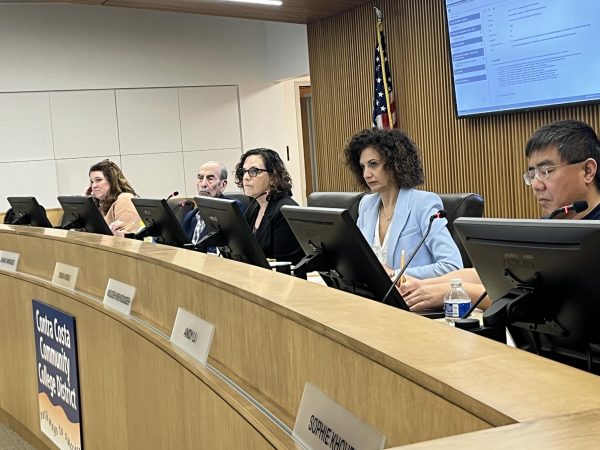
The college assured Santos that the decision was unrelated to his performance.“I was told this was strictly a budgetary decision and nothing connected with performance at all,” he said.
The move surprised faculty leaders and raised questions about the college’s strategy for expanding enrollment at a time when increasing enrollment has been identified as a key step in addressing the district’s financial deficit.
In an interview with the Advocate, the Academic Senate leadership said that they understand CCC is in a worse budget position than the other colleges in the district and that 2026–27 may be the toughest year. However, the elimination of some positions surprised many on campus.
Randy Carver, president of the Academic Senate at Contra Costa College, said “The Academic Senate was not involved early in the decision-making process and received only minimal notice about the proposed eliminations, including the learning disability specialist position,” Carver said.
“Personally, hearing that the dean of enrollment services position was eliminated was 100% a shock to me,” Carver added.
He said the decision appears to conflict with the college’s goal of expanding enrollment.
“I agree that it seems a little bit counterintuitive to eliminate the position of dean of enrollment services while also trying to ensure expanding our enrollment,” he said.
Carver said staffing reductions often shift additional work onto employees who remain and students are also likely to feel the effects. “Yes, it certainly will impact students in some way,” he said.
Santos said the college saw significant enrollment gains during his tenure.“Over the past four years, we were able to increase enrollment by 36 percent in FTES and about 34 percent in headcount,” he said.
Regarding his duties as a dean, he said the administrative role oversees key student-facing operations, including admissions and records, financial aid coordination, outreach to local high schools and the campus Welcome Center.
Still, he said, it remains unclear how the college plans to sustain enrollment growth without the position responsible for coordinating those efforts.
“I actually don’t know what the plan is to continue growing enrollment without this role,” Santos said.
Victoria Menzies, the college’s vice president of administrative services, said the decision reflects broader financial pressures facing the college.“The eliminated positions are important, but we have some positions where there’s duplication of effort or work,” Menzies said.
She added that administrators have a plan to redistribute the work but cannot yet share details.
“We do have a plan of how the work will continue, but it’s still confidential because it involves employees, and so we can’t release that,” she said.
Contra Costa College District is confronting a $1.8 million deficit this year, with financial conditions expected to worsen in the next academic cycle. As Menzies comment on the budget cuts crises. “ Next year, we will not have enough reserves to cover our current expenditures,” she added.
Menzies said the financial strain reflects changes in how California funds community colleges and continued enrollment challenges after the pandemic.
“The model changed. Before, it was focused on getting students into the classroom. Now the model is saying, get them in, give them the support they need, and get them out,” she said.
Regarding this crisis, Contra Costa College President Kimberly Rogers acknowledged the impact of the decision on staff and their families.
“These decisions carry real-life consequences for individuals and their families,” Rogers wrote in a campuswide message.
She added that the college will share more information about how services will continue in the coming days.
Tony Wold, associate vice chancellor and chief financial officer for the district, said student tuition represents only a small portion of community college revenue.“Student tuition only represents about 3% of community college revenue,” Wold said.
He also pointed to large differences in enrollment across the district’s campuses.
“DVC has over 15,000 FTES. CCC has 5,000 FTES. That’s a huge difference,” he said.
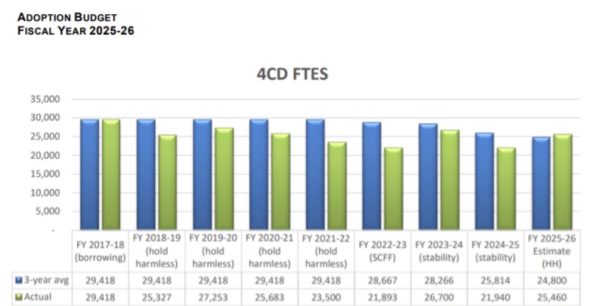
More broadly, Wold said community colleges receive significantly less funding per student than other public higher education systems.
“Community colleges are the least funded of all of the four educational organizations,” Wold said.
“The amount per student that the state funds for UCs is more than three times what they fund community colleges,” he added.
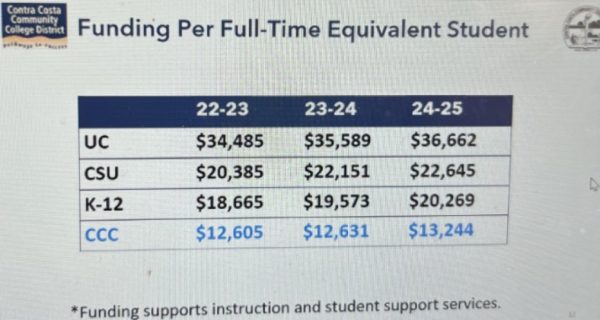
Funding per student in California shows a large gap between systems. Community colleges receive about $13,000 per student, compared to more than $36,000 at UC campuses.
Digging into history to alleviate the root of this crisis, the financial pressures facing California’s community colleges today trace back to the 2008–2012 state budget crisis, when a sharp economic downturn reduced tax revenues and forced the state to cut funding across public services, including higher education. During that period, community colleges experienced significant budget reductions, leading to fewer course offerings, reduced services and increased reliance on alternative funding models that later tied resources more closely to enrollment and student outcomes.
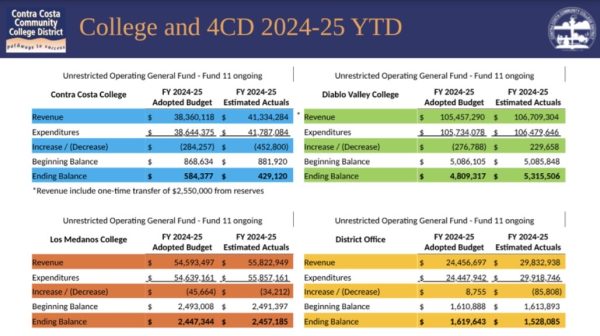
Budget data shows Contra Costa College operating at a deficit, while Diablo Valley College reports a surplus, reflecting uneven financial conditions across the district.
Wold said funding is largely driven by full-time equivalent students, or FTES. He said Contra Costa College serves about 5,000 FTES, compared to more than 15,000 at Diablo Valley College.
Because funding is tied to enrollment, campuses with fewer students receive less revenue. State data shows community colleges receive about $13,000 per student, widening the financial gap between campuses with different enrollment levels.
Taking all of that in consideration, Santos said the impact of staffing reductions often becomes visible first in student services. “When staff positions disappear, someone still has to do the work. That usually means longer wait times for students,” he said.
“For instance our financial aid office has only five full-time staff handling thousands of FAFSA and Dream Act applications,” he added.
In Santos office, there are a couple of family photographs that might appear ordinary to anyone; however, for Santos, these pictures mean a great deal since the district decision also carries a personal impact on his family.
“Hearing about the layoff was devastating for me,” he said.
Santos said the job loss comes during a difficult time for his family. Two years ago, his husband was diagnosed with a rare form of multiple sclerosis. After a fall and spinal surgery, Santos said his husband lost the ability to walk.
“Now my husband is using a motorized wheelchair,” Santos said.
“I’m worried about how we’re going to handle medical expenses and caregiving needs if my salary drops,” he said.
The college might offer Santos a teaching position as an instructor. However, the transition could significantly reduce his income.
“If I move into a faculty position, it would likely mean about a 30 percent pay cut,” Santos said. Despite the uncertainty, Santos said he hopes discussions about layoffs acknowledge the people affected by institutional decisions.
“We should never forget the humanity of the people working in our institutions.”