

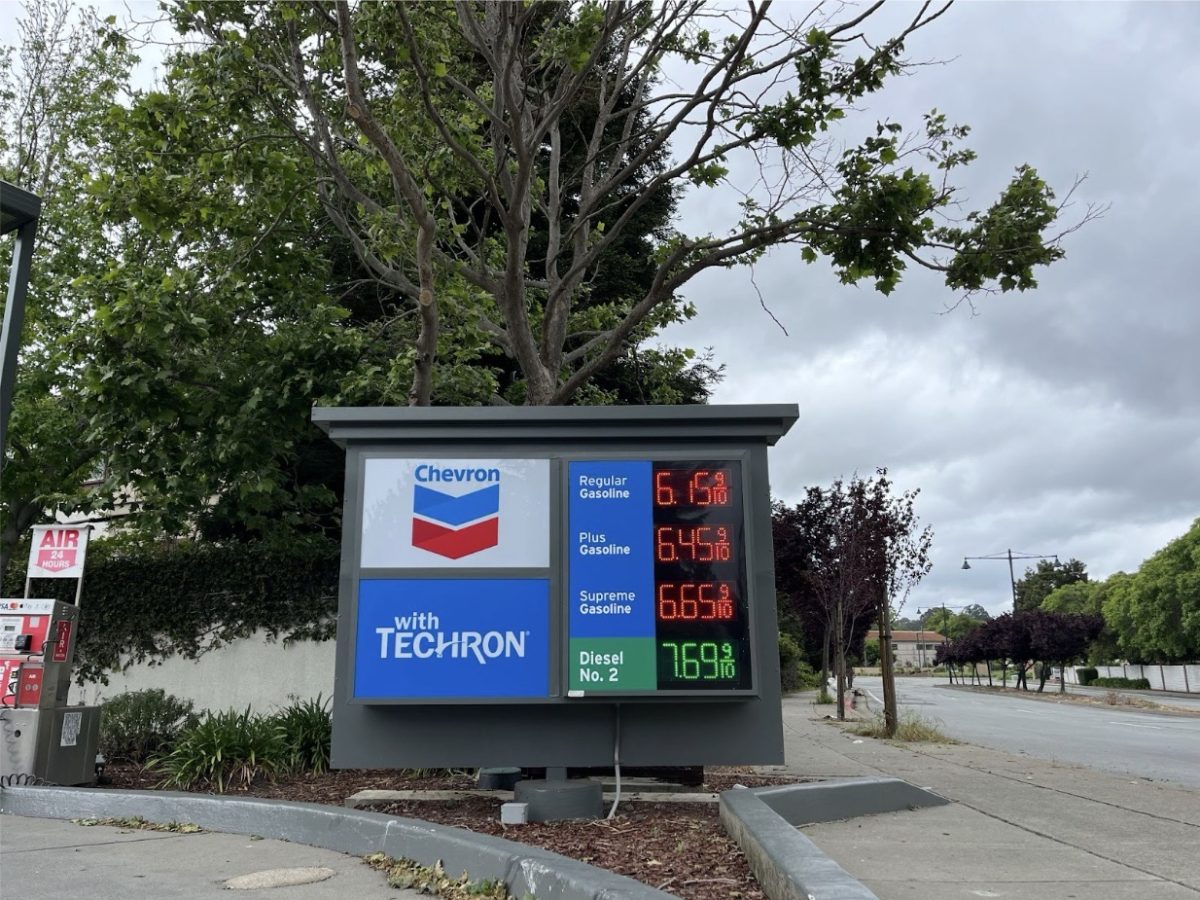
Gas prices near Contra Costa College have climbed past $5.50 a gallon as U.S.-Iran tensions push oil above $100 a barrel. Prices have reached their highest point since 2022, when Russia’s invasion of Ukraine and post-pandemic oil demand sent fuel costs soaring, according to CBS News, the war with Iran has caused oil prices to go above $100 per barrel, compared to $68 per barrel in 2025. With this rapid rise in fuel prices, Bay Area residents who rely on cars to get around are struggling to keep up with the cost of gas, particularly with the inflated prices and high cost of living in the Bay Area.
In a March 8th, 2026 post on Truth Social, Trump wrote that higher gas prices were “a very small price to pay for the U.S.A., and World, Safety and Peace.”
But as we enter the fifth week of the war, gas prices continue to rise, with little resolution to conflicts in the Middle East.
Near Contra Costa College, gas prices have made it to over $5.50 per gallon. This has affected many students who rely on their car to get to school.
Margot Johnson, a freshman at CCC, says that she started taking the bus every day to school because she cannot afford filling up her Toyota Prius’s tank consistently. The Chevron near her house has spiked to nearly $6.31 per gallon, so Johnson has resorted to only driving short distances or only necessary drives. Since the conflict began, Johnson has gotten a Clipper Start, which provides her with 50% off her rides.
Another student, Anya Scheglova, a fourth-year student at CCC, says that she has no other option than driving her car. Taking the bus would be inconvenient since she takes all of her school materials and needs a car to transport it.
Scheglova notes that the prices haven’t impacted her as severely as a hybrid-car owner.
In 2025, California hit record numbers of hybrid and electric vehicle purchases, making up 35.3% of Contra Costa County’s vehicle purchases, according to a [October, 2025] Los Angeles Times report
This may be helping to cushion the high prices for some residents as they make their way to school and work. Still, most students with hybrid and gas cars must endure the price because it’s the only convenient and reliable way to get to school.
This is not only a growing issue for students, but for teachers as well. Leslie Alexander, who is a chemistry teacher at Contra Costa College, says that she “just has to get here”, but that the gas prices are “shocking”. Teachers often bring all of their work to school, so taking the bus would be unfeasible for their daily commute.
Contra Costa College and the city of Richmond do offer options to those who want a more affordable way to school. The “Try Transit to College” Incentive is a program to get people to take public transportation instead of driving.
Students who pledge to try public transit through the program receive a preloaded $25 Clipper card. Richmond Moves is another alternative; it provides an Uber-like platform where you can order rides for free around Richmond. Additionally, the Clipper Start Program offers Clipper Cards for 50% off for Bay Area residents ages 19-64 who meet certain income and eligibility requirements. Eligibility requirements are available at clipperstartcard.com.
