

What is Measure G?
In short, Measure G allocates $920 million in government bonds to fund construction projects for the three colleges in the 4CD: Contra Costa, Diablo Valley, and Los Medanos Colleges. More specifically, this money is meant to fund the following; according to the actual text of the measure, which you can read here:
- update classrooms for science, nursing, and emergency response programs
- meet earthquake, fire, and accessibility codes
- repair outdated electrical, plumbing/ventilation systems
$920 million is a lot of money. How would Measure G be funded?
Measure G would be funded via government bonds.
Government bonds are loans sold to investors. They give both state and local governments a large chunk of cash they can use immediately to fund large projects like this, and in return the investors are paid back through interest over a series of decades through taxes.
Wait. More taxes? California’s already really expensive, I’m not going to have to pay even more, am I?
If you don’t own property? No. If you do own property? Yes.
State bonds are often paid back via income, sales, and corporation taxes. This is a local government bond however, which means it’s largely going to be paid back via property taxes instead. The best estimate given by 4CD is property owners paying $10 per $100,000 every year if Measure G passes up until 2059. This goes up to $27 per $100,000 when you include existing bonds from two Measure As in 2002 and 2006, and a Measure E in 2014.
If you own property and use this formula, you can divide the value of your property by 100,000, then take the resulting number and multiply this by 10 to estimate what Measure G would add to your bill.
The Advocate did this with Zillow’s average home price in San Pablo ($566,162) and got a resulting tax of $56.61 per year. If you include existing taxes from previous bonds (and replace that 10 with 27), you’ll get $152.83 instead. Note though, that the actual number is based on what the county thinks your property is worth, not a realtor.
Since the $10 per $100,000 figure was given by 4CD, however, some have questioned it. The Contra Costa Taxpayers Association (often shortened to CoCoTax), which is behind much of the No on G campaign, cites the tax levies as being one of the main reasons for their opposition. No on G’s estimate for taxpayers comes to $1,623 per person, a figure they got by dividing $1.88 billion (which they claim is what Measure G would cost with interest) by the total population of Contra Costa County. This formula, however, doesn’t take into account that not everyone in the county even owns property.
What are the arguments for Measure G?
Proponents of Measure G (which include the foundations for both Contra Costa and Diablo Valley Colleges, as well as a group called the International Brotherhood of Electrical Workers Local Union 302) say this is a must-pass item that would pay for needed improvements.
Guadalupe Lopez Villegas is both the campaign manager for Yes on G and a student of Diablo Valley College. Her enthusiasm for Measure G came from her first class on campus in an extremely old Language Arts building. Coming out of the COVID-19 pandemic, she said the building was in such poor shape that she seriously considered not coming to campus at all and taking all her classes online.

That didn’t happen, and Lopez Villegas came to love DVC, but she began to ask questions about what her classmates had gone through after remembering this experience. While some construction projects are already underway (including a new engineering and tech building meant to replace one with risk of asbestos poisoning and serious structural flaws), Lopez Villegas got no shortage of answers when she started asking her fellow students what they wanted fixed.
“I know some people, they call the humanities building the refrigerator, just because it’s really gloomy and cold. And I’ve heard people complain about that.” Lopez Villegas said.
One of the more egregious examples she pointed to was DVC’s childcare center, currently capped at 30 students. “And the reason for that is that half of the building is actually falling apart, not where the students are, but like, there is a whole area that is blocked off that could be used towards facilitating the education for single student parents.”
Accessibility was also a major concern at DVC in particular. While Contra Costa College is on relatively flat terrain, DVC’s campus was built on rather hilly terrain. “We want to make sure that students are able to navigate from one part of the campus to another.”

Lopez Villegas is not the only student who wants Measure G passed. In a show of how many students were interested in supporting Measure G, she said a fellowship of 15 students was created — with several student volunteers also jumping on board to help. “I’ve been pleasantly surprised by some students that have reached out to me directly to say, how can I get involved?”
What are the arguments against Measure G?
Mike Arata of CocoTax, one of Measure G’s biggest opponents, claims that the Contra Costa College District is fiscally irresponsible, cannot be trusted with this money and the student count is overinflated thanks to students enrolled in a single class. A report from the California Community Colleges Chancellor’s Office backs the full time student claim, with Contra Costa’s FTES (full-time equivalent students) being listed at 20,824.17.
On fiscal irresponsibility, not only did he point to the current salary of high ranking staff (with the Chancellor in particular making $447,840 as of Richmondside’s reporting in 2025), followed by a period of layoffs this year. Since Measure G is asking for far more money than all three previous bond measures, he feels this particular measure would be too much to ask for given the existing debt on these bonds, especially since Measure G in particular asks for a sum of money larger than the total of those three separate measures. “The whole thing seems disproportionate to me the more I look at it.”
He also pointed to this document, showing that Contra Costa has spent little on construction from 2010-2024, with a great deal of postponed maintenance projects on the books. While Measure G’s text explicitly says that it cannot be used for any other purpose than construction, with regularly scheduled audits and a new community oversight board to prevent mismanagement, Arata still worried the money would be mismanaged and go towards administration rather than construction itself.
How many people need to vote Yes on Measure G to pass?
Measure G needs 55% of Contra Costa County voters to pass, as required under Prop 39.
Where and when can I vote on Measure G?
Measure G will be alongside several items on the June 2 primary— including the gubernatorial race and the state superintendent’s race. Contra Costa County has created a list of polling places for the primary, simply search for your area code to see what’s near you.
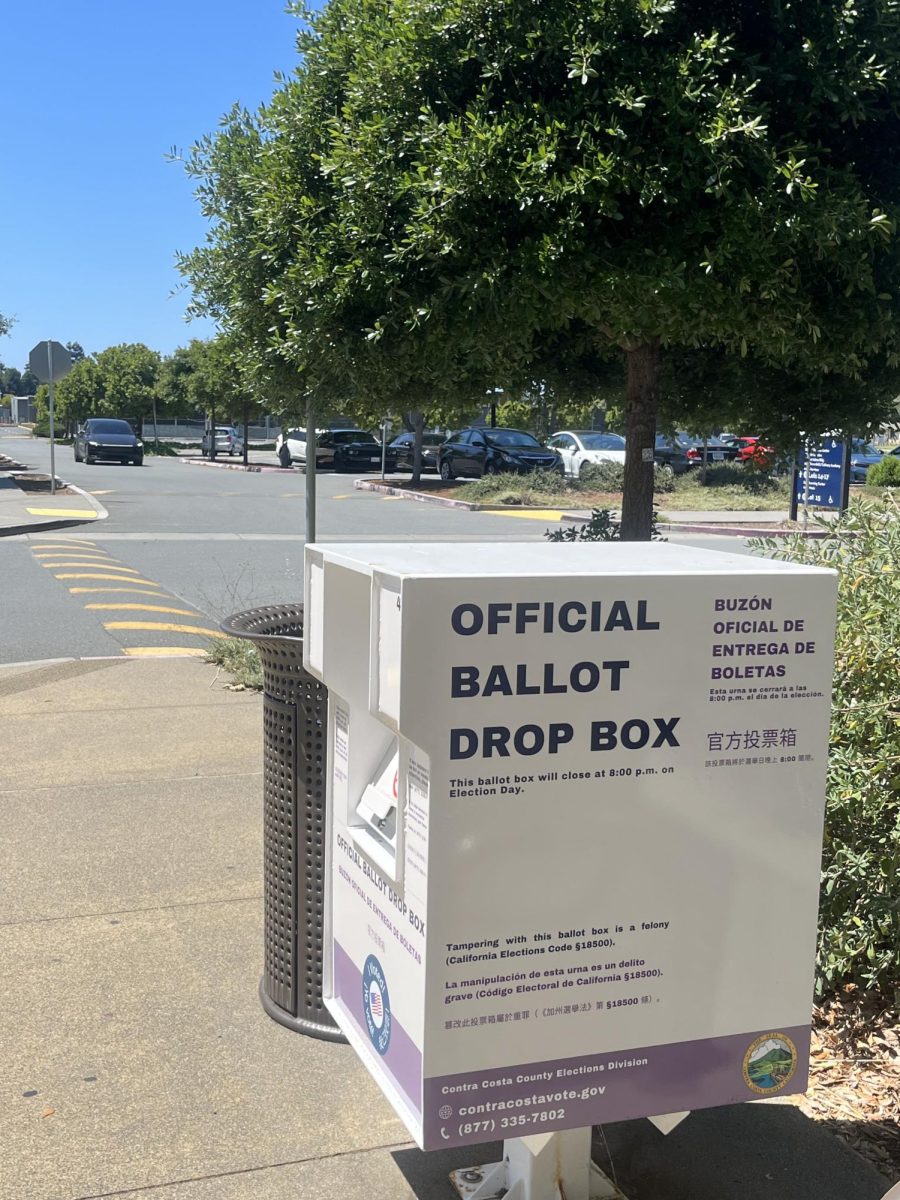
You can also vote via mail before then; there’s even a ballot box on Contra Costa College’s campus for exactly this purpose.

Michael Arata • May 16, 2026 at 8:28 pm
I appreciate Zoe Harwood’s reach-out to me for the “NO on G” assessment. Some important additions to Zoe’s report are in order, however….
1. Classroom updates “for… meet[ing] earthquake, fire, and accessibility codes; repair[ing] outdated electrical, plumbing/ventilation systems” (plus “roof repairs,” etc.) appear repeatedly in project lists associated with 4CD’s multiple bonds, typically as “deferred maintenance.” How many times must these projects be deferred before they are actually accomplished?
2. It’s correct that Measure G bond money cannot be used directly for salaries and benefits. But it would “free up” general fund dollars for those purposes. Ongoing building maintenance is supposed to be paid for from the same general fund that pays for salaries and benefits, including the lavish compensation levels of 4CD administrators, as outlined at NOonMeasureG.info.
So to the extent that ongoing maintenance is deferred, the money “saved” (for the moment) leaves more dollars available for compensation. When bonds are used for the deferred fixes that should have been covered in the general fund, those now more extensive repairs are then accomplished with borrowed money, interest on top.
3. As mentioned, Measure G’s total debt is scheduled finally to be paid off in 2059. Since bonds are loans, they add interest. The debt of $920 Million in principal alone is projected to add over $960 Million in interest, for a total of $1.88 Billion to be paid off. As I explained to Zoe, that’s not my number; it came directly from 4CD’s Facility Planning administrators, in the bond-payoff table I requested from them over two months ago, which I supplied to Zoe.
4. The three previous bonds (2002, 2006, 2014) themselves still require a total of $727 Million in aggregated residual payoff, in respective segments in 2030, 2038, and 2039.
5. It’s true, of course, that not all of Contra Costa’s residents own homes. So yes, indeed: Measure G would cost those who actually pay the tax considerably more than the $1623 per capita figure. But renters don’t necessarily escape those costs. Landlords have to figure their property-tax costs into rents charged. And Measure G would place a new lien on Contra Costa properties in every sale, rising with increases in assessed value.
6. The CCC Foundation’s $100,000 and DVC Foundation’s $50,000 in Measure G Proponent funding represent tax-exempt dollars — also tax-deductible by donors — a pattern seen increasingly in TK-12 schools too. Contractor unions have also contributed large amounts. They look to benefit directly and immensely from $920 Million in new spending if Measure G passes. In contrast, those who pay the taxes to fund 4CD bonds (and others like them) are typically not organized for large-dollar oppositional campaigns. The situation manifests what economists recognize as “Public Choice Theory.”
7. 30 years ago, a 4CD bond attempt included a campaign run from 4CD offices. The Fair Political Practices Commission fined the District $16,000 in total, for 8 counts of failing to file campaign-finance reports, for a campaign the District wasn’t legally able to operate in the first place. Back then, 1996’s Measure D spending plans included expenditures like $8,000 per classroom just to paint the walls; $5,000 per classroom merely to replace window coverings; and $50,000 each to “remodel classrooms.” Fortunately, Measure D failed.
Bay Area CPI inflation since then has increased costs generally by a factor of 2.3x. One can only imagine how far the project unit costs would now be inflated further for Measure G spending, were thatmeasure to pass.
8. Full-time equivalent students (FTES, = total course hours for all students divided by 525, the equivalent of 15 hours x 35 school weeks) numbered over 30,000 in 4CD when the 2002 bond passed. 4CD’s total FTES number reported to the State Chancellor in October for the 2024-25 school year was 21,940.11.
9. Contra Costa taxpayers need to keep in mind the totality of new taxes on tap (atop high existing taxes), including local district bond measures and parcel taxes, Measure B’s 0.625% sales-tax increase, the 0.500% transit sales-tax increase planned for November…. Tax-spending agencies need themselves to realize that their high tax loads are driving taxpayers out of California.